Article status: Draft
Time Estimate for Reading: 15 min
Learning Objectives: Concept of Moment and Work
Effort Required: Medium
Pedagogy Model: Evolution based
Prior Physics Concepts: displacement, velocity, acceleration, mass, power, force
Prior Math Tools: Secondary school level Arithmetic, geometry and algebra
It has been a great journey so far. Starting from space, time and mass, we have come quite some distance from tower of Pisa and Galileo. or should i say displacement?
Looking back at our journey,
Considering only space and time, we added displacement, velocity and acceleration to our vocabulary. That is all an object can do. May be remain at rest or continue in motion. Motion being of uniform velocity or of uniform acceleration. We carefully avoided 'jerk' in our journey. jerk is non-uniform acceleration and is not a comfortable experience.
Different objects, distinguished by its mass can be in motion. So, motion should take the mass of object into consideration. so, we discussed about power of motion and power of rest. The power of rest introduced us to the concept of force. The concept of force led us to the concept of mass and with that we were able to distinguish between mass, weight and force.
With that in perspective, there are few more concepts that we may add to our vocabulary. As much as we deduced force from power of rest, we shall also deduce the the concept of Work and Energy from the power of motion.
We shall look at the concept of power objectively and also take a peek at the way the concept of work evolved. The concept of energy has to wait for one more article.
Objective perspective:
power = mass * acceleration * velocity
Power is measured in Watt's.
When there is more than one variable (m, a and v in this case) mathematicians, scientists and physicists always like to play with them or try different combinations. shall we say cook things with the same ingredient but different recipes.
p = m * a * d/s (velocity is m/s)
What are the different combinations. Mathematically speaking we have two choices. Use permutations or combinations. We choose to use combinations instead of permutations (as order is not important).
mass * a has been given the word force . Force measured in Newton's.
- mass/second does not seem to make any meaning (in fluids we shall introduce mass flow rate).
- acceleration per second or rather change is acceleration per second has been carefully ignored
- mass * displacement also does not seem to make any meaning.
Can we make out something by F * d (force into displacement). A big Yes. But not from manipulating the formula. It comes from analyzing the concept of Lever. Lever would be the first of simple machines. The famous Archimedes (300 BC) statement of "Give me a Lever and the earth shall be lifted"

Examining the picture of Archimedes with lever, The triangle, rather a 3 dimensional prism, is the support point (fulcrum). The effort is to be applied by the hand of Archimedes. The load to be lifted is the earth.
For a little review of the historical importance, you may take a look at this link.
Now is the time to introduce the concept of rigid body. In the articles so far, we have been discussing about a particle at rest or in motion. A particle necessarily we assumed as a spherical object, with all of its mass concentrated at a single point.
A rigid body need not be spherical. It can have different shapes. May be imagine balancing a broom stick

Observe that the support point is not the geometrical center, but shifted to one side. The point on the object at which support is provided is called the center of mass or center of gravity (since gravitational acceleration is constant at the surface of earth).
Request you to take some time off to watch some videos on application of this lever and center of mass principle. The Equipois and Steadycam. Salute to Mr Garett Brown, the self taught innovator.
The principle of the lever:
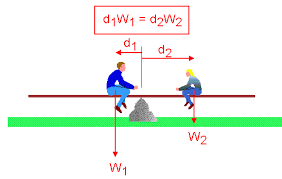
For the lever to be equilibrium (equilibrium is the word used for rigid body at rest),
- provide a support at the center of mass.
- The product of weight and distance on either side should be equal.
This product of W and d is given a word called moment. We may replace Weight with Force. Force is a more generic word and provides a more generic definition for moment. Moment is the product of force and perpendicular distance from the point of support.
At this juncture, recall that, there is another word called momentum which is a product of mass and velocity. Watch out the effect of adding 2 letters 'um'. It leads to a totally different meaning.
We were discussing on the concept of rest when we considered a particle. Similarly, for a rigid body to be at rest we need to introduce the concept of equilibrium. So, for a rigid body to be at rest, it should be in both force equilibrium (center of gravity should not move) and moment equilibrium (rigid body should not rotate).
Having discussed on the concept of center of mass, moment, force equilibrium and moment equilibrium let us move forward to get to the concept of work.
Using the concept of moment equilibrium (otherwise called as lever principle), we can
lift any object. may be that is why Archimedes said he can lift the earth. Just put in the mass of earth (5.972 × 10^24 kg) and mass of Archimedes (approx 100 kg) in the formula. We would require a lever of length approx 5.972 × 10^22 meters. Compare this with circumference of earth 4.0075 * 10^4 m. we need a lever roughly 20 orders of magnitude.

 For the sake of completeness, Simon Stevin's inclined plane experiment seems to have helped establish the concept of Work. With this experiment, Stevin used the concept of Weight * displacement along the inclined plane. Earlier to this people seem to have tried to establish a relationship with force and angle of inclination.
We began with Galileo (Momentum=mv), Watt (Power = w/s), Newton (Force=ma) and now we have reached Joule (Work=Fd).
Time Estimate for Reading: 15 min
Learning Objectives: Concept of Moment and Work
Effort Required: Medium
Pedagogy Model: Evolution based
Prior Physics Concepts: displacement, velocity, acceleration, mass, power, force
Prior Math Tools: Secondary school level Arithmetic, geometry and algebra
It has been a great journey so far. Starting from space, time and mass, we have come quite some distance from tower of Pisa and Galileo. or should i say displacement?
Looking back at our journey,
Considering only space and time, we added displacement, velocity and acceleration to our vocabulary. That is all an object can do. May be remain at rest or continue in motion. Motion being of uniform velocity or of uniform acceleration. We carefully avoided 'jerk' in our journey. jerk is non-uniform acceleration and is not a comfortable experience.
Different objects, distinguished by its mass can be in motion. So, motion should take the mass of object into consideration. so, we discussed about power of motion and power of rest. The power of rest introduced us to the concept of force. The concept of force led us to the concept of mass and with that we were able to distinguish between mass, weight and force.
With that in perspective, there are few more concepts that we may add to our vocabulary. As much as we deduced force from power of rest, we shall also deduce the the concept of Work and Energy from the power of motion.
We shall look at the concept of power objectively and also take a peek at the way the concept of work evolved. The concept of energy has to wait for one more article.
Objective perspective:
power = mass * acceleration * velocity
Power is measured in Watt's.
When there is more than one variable (m, a and v in this case) mathematicians, scientists and physicists always like to play with them or try different combinations. shall we say cook things with the same ingredient but different recipes.
p = m * a * d/s (velocity is m/s)
What are the different combinations. Mathematically speaking we have two choices. Use permutations or combinations. We choose to use combinations instead of permutations (as order is not important).
mass * a has been given the word force . Force measured in Newton's.
- acceleration per second or rather change is acceleration per second has been carefully ignored
- mass * displacement also does not seem to make any meaning.
Can we make out something by F * d (force into displacement). A big Yes. But not from manipulating the formula. It comes from analyzing the concept of Lever. Lever would be the first of simple machines. The famous Archimedes (300 BC) statement of "Give me a Lever and the earth shall be lifted"
Examining the picture of Archimedes with lever, The triangle, rather a 3 dimensional prism, is the support point (fulcrum). The effort is to be applied by the hand of Archimedes. The load to be lifted is the earth.
For a little review of the historical importance, you may take a look at this link.
Now is the time to introduce the concept of rigid body. In the articles so far, we have been discussing about a particle at rest or in motion. A particle necessarily we assumed as a spherical object, with all of its mass concentrated at a single point.
A rigid body need not be spherical. It can have different shapes. May be imagine balancing a broom stick
Observe that the support point is not the geometrical center, but shifted to one side. The point on the object at which support is provided is called the center of mass or center of gravity (since gravitational acceleration is constant at the surface of earth).
Request you to take some time off to watch some videos on application of this lever and center of mass principle. The Equipois and Steadycam. Salute to Mr Garett Brown, the self taught innovator.
The principle of the lever:
For the lever to be equilibrium (equilibrium is the word used for rigid body at rest),
- provide a support at the center of mass.
- The product of weight and distance on either side should be equal.
This product of W and d is given a word called moment. We may replace Weight with Force. Force is a more generic word and provides a more generic definition for moment. Moment is the product of force and perpendicular distance from the point of support.
At this juncture, recall that, there is another word called momentum which is a product of mass and velocity. Watch out the effect of adding 2 letters 'um'. It leads to a totally different meaning.
We were discussing on the concept of rest when we considered a particle. Similarly, for a rigid body to be at rest we need to introduce the concept of equilibrium. So, for a rigid body to be at rest, it should be in both force equilibrium (center of gravity should not move) and moment equilibrium (rigid body should not rotate).
Having discussed on the concept of center of mass, moment, force equilibrium and moment equilibrium let us move forward to get to the concept of work.
Using the concept of moment equilibrium (otherwise called as lever principle), we can
lift any object. may be that is why Archimedes said he can lift the earth. Just put in the mass of earth (5.972 × 10^24 kg) and mass of Archimedes (approx 100 kg) in the formula. We would require a lever of length approx 5.972 × 10^22 meters. Compare this with circumference of earth 4.0075 * 10^4 m. we need a lever roughly 20 orders of magnitude.
Evolution of Work as a concept in physics:
Leaving that aside, we also understand from our experience that, nature does not offer any free lunch. To gain something we need to loose something.
Observe the displacement of load and displacement of effort. Force * displacement along the line of application of force. Effort has to applied over a longer distance to lift the load through a shorter distance. So, it is only natural for physicist's to come up with another concept. The concept of Work. Work is the product of Force and displacement along the line of application of force
W = F * d. Force in Newton's and displacement in meters. The unit of work is Nm. Like force is measured in Newton's, Work (Nm) is measured in Joules. Work is just an abstract concept but as we move on, we shall understand the importance of it application in modeling physical systems.
With the introduction of work, Power gets a proper definition. it is the rate of doing work.
P = W/s and is measured in watt's.
We began with Galileo (Momentum=mv), Watt (Power = w/s), Newton (Force=ma) and now we have reached Joule (Work=Fd).
But Joule seems to have multiple faces. To know about the different faces of Joule, we need to understand yet another abstract concept called energy. Rather potential and kinetic energy.
Joule's different Faces:
Moment = f*d measured in Nm
Work = f*d measured in Nm again
Potential Energy = m*g*h measured in Nm again
Kinetic Energy = 1/2 m*v^2 measured in Nm again
We have been considering only straight line motion so far. once we complete our discussion on energy (potential and kinetic) in the following article, we can connect the dots and clear the missing links.
By now we have collected enough tools to tread into the field of 2 dimensional rotational motion. There are 2 more concepts which have the same unit as Nm.
Torque = Force * radius measured in Nm
Couple = Force *distance measured in Nm again
There are 6 concepts in physics with the same unit of Nm. Joule seems to have six faces and it would be nice to know them all. On a lighter note, just imagined joule with six faces and wondered how joule would listen and talk to six people at a time. Really enjoyed the thought experiment. Leave alone the challenge of we talking to a person with six faces.
Now back to physics, this was the area which took a lot of time to crack. it took close to 7 years for me to get to terms. it was a tough journey. may be my IQ levels are low. End of the day, happy that i made it this far.
Let us move on with our journey into yet another abstract concept; Energy.
References:
https://www.math.nyu.edu/~crorres/Archimedes/Lever/LeverLaw.html
https://www.math.nyu.edu/~crorres/Archimedes/Lever/LeverLaw.html


